Monday, 26 October 2015
In search of Gaelic, my road trip to the Isle of Lewis
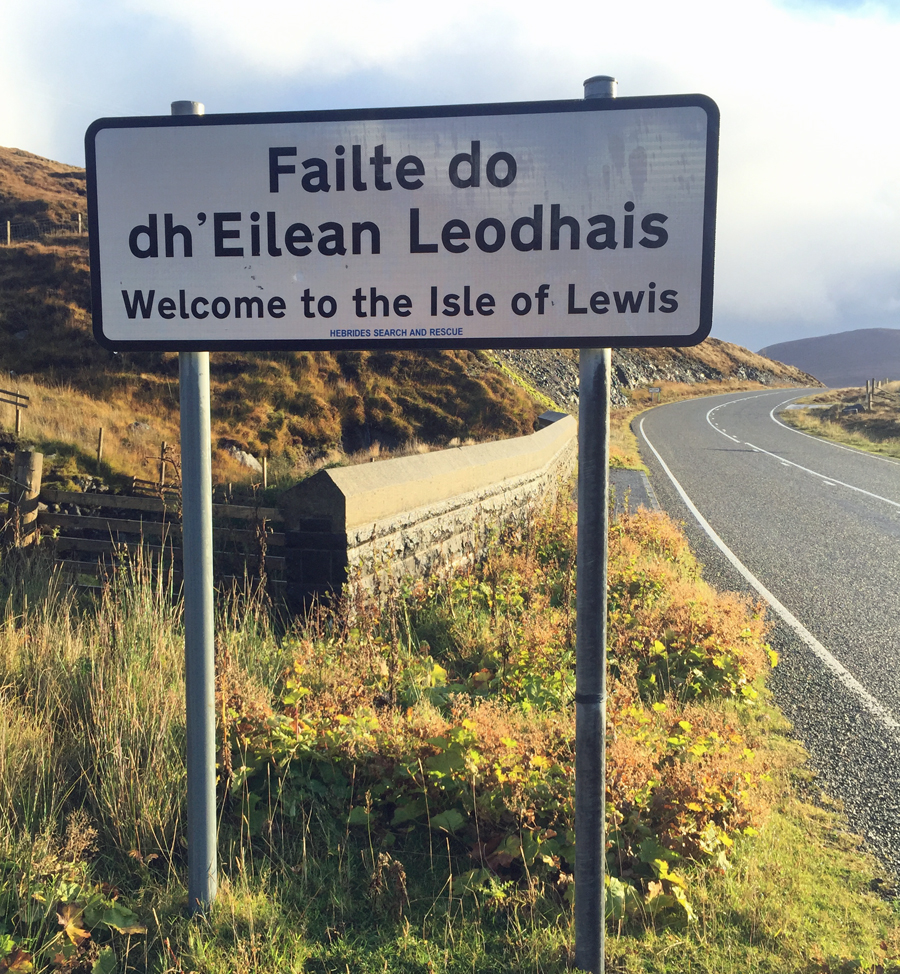
Last week, in an attempt to improve my spoken Gaelic and try and do something about my horrendous English accent, I nipped up to the Isle of Lewis for a couple of days.
Being a bit of a ferry geek, I was keen to take a trip on CalMac's new ferry the Loch Seaforth. Like most folks I have spoken to, I find it smart and swish but full of design quirks that beggar belief. The main thing is the televisions. Gees! There are TVs everywhere! Even in the lounge where you sit with the dog, all the seats face one way and there is even a TV on the wall BEHIND all the seats, so you'd have to crick your neck 180 degrees to even see it.
Nice ferry CalMac. Just ditch the tellies, please!
Not one was showing BBC Alba of course, but full marks for the Gaelic announcements on board.
My accommodation in the village of Achmore (near Leurbost) was at a B&B called Westend, run by Gaelic Tutor and local celeb Maggi (Magaidh) Smith.
You'll see on Magaidh's sign something I wish other Gaelic-speaking B&Bs would do - be PROUD of the Gaelic spoken! I was welcomed with tea and biscuits and a warm craic in Gaelic. It was then that I realised that I'm not as fluent as I would like to be, but hey. We spoke English when I couldn't cope any more, so don't feel that you need to speak Gaelic if you don't want to. As is the mantra at Sabhal Mòr Ostaig, it is all about just using the Gaelic that you have, no more and no less.
For £30 per night including a nice brekky of fresh fruit, muesli, cereal, and yogurt, it was a nice place to stay. The room was cosy, clean and comfy. It does lack a desk but Magaidh allowed me to use her camping table in the laundry room. Wifi ('island' speed) is included. OK for basic browsing, but don't try and download anything.
The new, immaculate shower room and WC is directly across the hall, and as this is the only guest room Magaidh has, you have exclusive use.
Like many islanders, Magaidh has about 395 jobs on top of all the charity and voluntary work she does. Conversation opportunities were limited to breakfast, and a chat in the evening - pretty much the same as any B&B host. However, for an additional fee you can book her for an hour or so if you need to go through anything you're stuck on. It's definitely worth calling for a chat first if you are coming here on an informal language break.
Most of my Gaelic conversation was with friends that I had met beforehand. However, one evening Magaidh was running a wee cèilidh in Stornoway and I was invited to that. Sadly, there was limited opportunity to speak Gaelic as most of the native speakers spoke to me in English as usual.
All in all I had a nice time and enjoyed my autumn break on the beautiful Isle of Lewis. Every time I visit Lewis, I fall in love with it just a little bit more.
As for the Gaelic, you will get nowhere near as much from such a break as you would from a short course at Sabhal Mòr Ostaig - here there is far more of the 'holiday' element. However, you'll get a stack more opportunity to use what Gaelic you have by staying here with Magaidh and being introduced to local folks than you would by staying in an impersonal hotel.
Monday, 19 October 2015
Come out of the closet!
The nervous teenage boy enters his parent's sitting room.
'Mum, Dad, I have something to tell you. I'm Gael.'
Mum bursts into tears. Dad gets angry.
'But...but why son? Was it something we did? I KNEW we should never have had that holiday in Barra in 2009.'
'It's just the way I am. I've been surpressing it long enough, and I can't hold back any more. I'm Gael.'
Mum dries her eyes. 'I should have guessed. You left your computer on once and I saw you'd been looking at dirty websites like learngaelic.net. I've heard you listening to 'Beag Air Bheag' podcasts through your headphones. I even found those disgusting magazines under your mattress. Yes, those Sabhal Mòr Ostaig course notes and prospectuses from those 'weekends away' when you pretended you were going to the city with your mates to get off your face on booze and drugs and end up in trouble with the Police. But they were all lies weren't they? You were sneaking off up to weekend schools in Skye, learning the Gaelic, playing the fiddle, reciting poetry, singing songs and other such disgusting behaviour. How could you? HOW COULD YOU?'
OK, so this is all a bit tongue in cheek, but I'm prompted to imagine this scenario by two separate thoughts.
First off, it's to help my own understanding of why someone from the South East of England feels such a strong affinity with the Highlands and Islands, and Gaelic, despite the lack of roots. Well, sometimes strength of feeling cannot be explained logically, it just IS. Think of the men and women 'trapped' in the 'wrong' bodies. Transexuals are often ridiculed, but I for one think that you'll not find a a stronger and a tougher band of people. These folks have such a strong feelings from within that they are prepared for the mental and physical battle that lies between the gender that they are born with and the gender at which they will finally be at peace. As someone who is very happy in my own skin, I don't really understand it, but that doesn't mean to say I don't respect and admire these folk. Live and let live and celebrate diversity.
So while I'm happy with my skin and who I am, I often feel like there is a Gael deep down inside me busting to get out. I don't understand it, but am taking on the tough battle to let it out. Thank goodness I don't have to go through painful surgery or psychological analysis.
Just like the transgender man living as a woman before the operation has to endure the jibes and sneers of the mob, the Englishman learning Gaelic has to endure the thinly-veiled racism of the anti-English brigade. References to the 'Auld enemy,' 'the Bad Side of the Border,' and far, far worse will always serve to remind me that I am alone in a place where people hate the place where I was born and brought up. Yet, rather than give it all up, us English folk learning Gaelic just have to shoulder it and get on with it. Yes, there are many aspects of English Culture, History, and Politics about which I am deeply unhappy, but that doesn't make me as an individual responsible for any of them. As for History... well, so much of that is placed in a romantic light by dreamers who forget about one crucially important factor, and that is context. Dreamers and romantics refer to historical events in a modern-day context, which skews fact and interpretation. Do I hold my German friends accountable for the destruction of my corner of the country and the loss of life 100 and 75 years ago? No. Do they hold me accountable for Dresden and the like? No. We shall never forget, but we shall also move on.
As for 'coming out of the closet,' it still amazes me how many Gaelic speakers hide their language and culture. Of course, Gaels are notoriously polite, decent, and modest folk, and their lack of arrogance and selfishness is one of the main reasons that I find the whole culture so utterly amazing and wonderful. However, this in itself brings additional challenges for the learner.
Let's look at our friends in the Gay Community. A generation or two ago, even the most placid and peaceful men and women were faced with no option than to be vocal and visible. It was the only way to get their rights to be who they are accepted and integrated into wider society. There is still some way to go, but things are moving in the right direction. A generation or two ago, if a train driver announced he was gay in the messroom it could have ended in his being ostracised and cut off, excluded and lonely until possibly he ended up on a downward spiral. I say 'he', because women didn't drive trains then. Nowadays, if a train driver announced that he or she was gay, it would be about as exciting and controversial as what was on the menu at the staff canteen.
What has this to do with Gaelic? Well, there is just so much of it in the Closet, and that makes it difficult for the learner and the would-be learner to find it being used in everyday life. Bigots will always put down minority groups because bigots are ignorant, and ignorance promotes fear. Ignorance means that they don't understand it so they try to kill it. When cultures and lifestyles are dragged out into the open and life doesn't end because of it, ignorance gradually fades.
Right now, the only way for somebody to learn Gaelic as an adult is to do it through some kind of a course. Ùlpan is the least academic course, but these courses are few and far between, and they never seem to be consistent or structured in their occurrence. The only clear courses with a clear progression path are the academic ones, at Sabhal Mòr Ostaig in Scotland and a few other colleges and universitites in the UK.
However, on social media I have been following a few Gaels who are disparaging towards the 'academic' approach to Gaelic. It's true that when you're at Sabhal Mòr, you are surrounded by people who have the time, brain power, and financial means to devote to an Academic Course. It is a luxury not everyone can afford, and in a chat with other students, we voiced concern that Gaelic is becoming a Luxury Language for the Middle Classes.
But what are the options, when Gaels refuse to speak Gaelic outwith people they know?
I am on a bit of a personal mission to find Gaelic outside the classroom. I have searched for homes or farm stays where guests can stay for a week with a Gaelic-speaking family and pick up what they can. So far, I have not found any such thing. I am sure that there are many farms, B&Bs, cafes, and other social places where Gaelic is spoken, yet this fact is never advertised. Just like some places are 'Bikers Welcome' or 'Walkers Welcome', howabout a scheme where 'Gaelic Spoken' is used in marketing? It would make life a lot easier for us intermediate learners who are looking for opportunities to consolidate all those words and grammar that's jumbled about in our heads into real-life sentences outside the classroom.
I have found one - just one - B&B where Gaelic is not just spoken, but it is promoted. That B&B is on the Isle of Lewis, and tomorrow I will head on up there to check it out. When I phoned to book and spoke Gaelic to the landlady, she never once reverted to English, even when I struggled. Now THAT is the kind of thing I'm looking for! Stay tuned and I'll tell you how it goes.
Wednesday, 9 September 2015
The Invisible Gift Horse
![]() |
| Awaiting the Right Away, Scotland Bound again |
There are many rewards, and frustrations, with learning Gaelic.
One of the frustrations I'm finding at the moment is that nobody within the Gaelic speaking community appears to acknowlege the existence of a very powerful asset that they have. Nobody appears to be looking outside the long-established bubble.
Anti-Gaelic bigotry is real, and I've only come across it in Scotland. Right now, some very narrow-minded and blinkered folk are working themselves up into a state about bilingual road and rail signs.
Yes, really!
Personally (maybe I'm biased) I love to see the bilingual signs. To my wide eyes they add a sense of place to this beautiful country, a 'uniqueness' that you only find outside England. It's also a daily reminder to non-Gaelic speakers of their native language's existence.
The bigots will argue that to support Gaelic is a waste of public money. In retort, the pro-Gaelic lobby will argue with the facts and figures that would suggest that money spent on the language is but a drop in the ocean. We could all find public projects that we don't agree with, but the joy of living in a democracy is that we need to allow others to enjoy their passions, skills, and creativity even if we don't understand. Even stuff we don't necessarily like or agree with adds to the fantastically rich and diverse culture of Scotland and of Great Britain in general. Me, I have no interest whatsoever in football. I don't really agree to my taxes paying to Police football matches, but a few million football fans would disagree with me. We live and let live.
Recently there was a survey about Gaelic learners. The study focussed soley on learners based in Scotland. During a recent course at Sabhal Mòr Ostaig, we were asked by a third party to give our feedback and ideas for BBC Alba. My form was whipped away from me when I said I was resident in England, as my views would be null and void. This is slightly ironic as a licence fee payer who mainly watches BBC Alba, albeit by the wonder of the internet or satellite.
My major source of frustration, as I hinted earlier, is that I don't really exist in the wider Gaelic picture. Neither do my friends R, M, M, J, and E in London. Or R in Wales. Or M&C from Misouri. Or S from Germany. Or anyone else living outwith Scotland who spends a considerable amount of their income on Gaelic.
It's not just the Cùrsaichean Goirid and the Cùrsaichean Air Astar that we pay (non-Scottish rates) for. There's the travel, the food and accommodation, and the countless cultural trips to Glasgow, the Highlands, and the Islands that we make. Ever since my discovery of the Outer Hebrides in 2009, I have been hemhorraging my hard-earned English pounds in Scotland. Like many of my learner colleagues and friends, learning Gaelic is a way for us to get right underneath and into this beautiful country and its culture.
For the fact and figure lovers, here is my spending over the last 12 months:
Cùrsa Adhartais, 4 x modules @ £450 = £1800
Cùrsa goirid, two weeks at approx £500 p/w including board & lodging: £1000
Food, lodging, site fees, fuel, ferry, accommodation in Glasgow, Highlands & Islands: £2,200
So that's £5000 or thereabouts from me alone. November/December last year was Harris and Lewis. January was Celtic Connections in Glasgow. Mar/Apr/May was a three month island tour. I'm intending to sneak a wee trip or two to Staffin and/or Tiree before the end of the year, as well as basing myself in Glasgow for 10 weeks just to improve my accent.
There are hundreds of us making the pilgrimage to Scotland every year to immerse ourselves in the Gaelic language and culture. Coming to Scotland - where the landscape speaks Gaelic - is a ritual we enjoy. We spend lots of money while we're doing it, as do visitors who are not Gaelic learners, but see the language and the culture as part of the very fabric of Scotland that they find so attractive.
I may be wrong, but as far as I am aware we are not being counted. I cannot find evidence of our existence in any report or study that I have come across. Here is this wonderful, gift-wrapped present for the pro-Gaelic lobby to exploit and highlight; this body of non-Scottish learners demonstrating that Gaelic can be, and is, a money magnet as well as a cultural asset.
Yet despite our contribution and commitment, we seem to remain invisible.
I'd love to be proved wrong. I hope I will be.
Monday, 3 August 2015
'Getting' the future tense
The verb 'faighinn' in the future tense.
Irregular verbs, don't you just love 'em? There aren't actually that many in Gaelic compared to some other languages, but there are a few there with the primary purpose of being a challenge to remember.
In order of 'stem - past tense - future tense,' my four nightmare verbs are:
rach - chaidh/cha deach - thèid (go)
abair/can - thuirt - canaidh (say)
faigh - fhuair/cha dh'fhuair - gheibh/chan fhaigh (get)
thoir - thug - bheir/cha toir (give)
I find it really hard to commit these forms to memory. 'I went' is 'Chaidh mi...' yet 'I didn't go' is 'Cha deach mi...', as irregular in Gaelic as it is in English. Then in the future form you get another word - thèid - but at least this is fairly consistent throughout, dropping its lenition when making pronounciation easier.
The best way to remember things, of course, is to get them to make you laugh.
My 'Caraid Cànan' M made me laugh the other day with the verb 'get' in the future tense, and finally it has stuck.
All through the future tense, it's 'faigh' (rhymes with 'high'), with or without lenition, except the simple future which is a completely different word: Gheibh, loosely pronounced 'yeahv'.
Now, if you've been learning Gaelic more than a couple of months you'll soon be told that the phrase 'mas e thu toil e' ('if you please') is never, EVER uttered by native Gaelic speakers in everyday use.
Manners are implied by use of tense and the question form, so while 'bheir sibh dhomh cupa tì' (give me a cup of tea) is as direct and rude as it sounds in English, the phrase 'am faigh mi cupa tì?' (may I get a cup of tea?) is normally used instead. Forget sounding American, 'am faigh mi...' was around for a long time before English-speaking folk started imitating their American cousins.
So... we're used to 'am faigh mi...', to which of course the response in the negative is 'chan fhaigh' (easy enough to remember) but in the positive is 'gheibh'. Gheibh, as already mentioned, bearing no resemblance to the root 'faigh'.
So... how to remember this?
A great way to remember this is to think of the non-Gaelic speaker visiting a Gaelic speaking canteen-style cafe, and trying their best with the people serving the food:
'Am faigh mi seo?' (May I get this?) 'Gheibh' (You may)
'Am faigh mi seo?' 'Gheibh'
Perplexed, our non-Gaelic speaker takes his food to his table and quietly has a word with his Gaelic friend.
'Well, they're a cheery bunch in here' he says to his friend.
'What do you mean?'
'Well, every time I used that phrase you taught me to get something, they practically cheered! I thought they were going to high-5 me every time!'
'I still don't get what you mean.'
'When I asked for and pointed at the fish, they went 'YEAH!'. Then when I asked for peas, they went 'YEAH!!' Then when I asked for chips, they again went 'YEAH!!!' Are they always that happy?'
His friend thought briefly, then put his hand over his eyes: 'Gheibh' said the friend. 'Gheibh'.
Now, can anyone think up a joke for chaidh/cha deach/thèid? ;)
Irregular verbs, don't you just love 'em? There aren't actually that many in Gaelic compared to some other languages, but there are a few there with the primary purpose of being a challenge to remember.
In order of 'stem - past tense - future tense,' my four nightmare verbs are:
rach - chaidh/cha deach - thèid (go)
abair/can - thuirt - canaidh (say)
faigh - fhuair/cha dh'fhuair - gheibh/chan fhaigh (get)
thoir - thug - bheir/cha toir (give)
I find it really hard to commit these forms to memory. 'I went' is 'Chaidh mi...' yet 'I didn't go' is 'Cha deach mi...', as irregular in Gaelic as it is in English. Then in the future form you get another word - thèid - but at least this is fairly consistent throughout, dropping its lenition when making pronounciation easier.
The best way to remember things, of course, is to get them to make you laugh.
My 'Caraid Cànan' M made me laugh the other day with the verb 'get' in the future tense, and finally it has stuck.
All through the future tense, it's 'faigh' (rhymes with 'high'), with or without lenition, except the simple future which is a completely different word: Gheibh, loosely pronounced 'yeahv'.
Now, if you've been learning Gaelic more than a couple of months you'll soon be told that the phrase 'mas e thu toil e' ('if you please') is never, EVER uttered by native Gaelic speakers in everyday use.
Manners are implied by use of tense and the question form, so while 'bheir sibh dhomh cupa tì' (give me a cup of tea) is as direct and rude as it sounds in English, the phrase 'am faigh mi cupa tì?' (may I get a cup of tea?) is normally used instead. Forget sounding American, 'am faigh mi...' was around for a long time before English-speaking folk started imitating their American cousins.
So... we're used to 'am faigh mi...', to which of course the response in the negative is 'chan fhaigh' (easy enough to remember) but in the positive is 'gheibh'. Gheibh, as already mentioned, bearing no resemblance to the root 'faigh'.
So... how to remember this?
A great way to remember this is to think of the non-Gaelic speaker visiting a Gaelic speaking canteen-style cafe, and trying their best with the people serving the food:
'Am faigh mi seo?' (May I get this?) 'Gheibh' (You may)
'Am faigh mi seo?' 'Gheibh'
Perplexed, our non-Gaelic speaker takes his food to his table and quietly has a word with his Gaelic friend.
'Well, they're a cheery bunch in here' he says to his friend.
'What do you mean?'
'Well, every time I used that phrase you taught me to get something, they practically cheered! I thought they were going to high-5 me every time!'
'I still don't get what you mean.'
'When I asked for and pointed at the fish, they went 'YEAH!'. Then when I asked for peas, they went 'YEAH!!' Then when I asked for chips, they again went 'YEAH!!!' Are they always that happy?'
His friend thought briefly, then put his hand over his eyes: 'Gheibh' said the friend. 'Gheibh'.
Now, can anyone think up a joke for chaidh/cha deach/thèid? ;)
Monday, 20 July 2015
We Need to Talk - and the Solution is Simple
Learning Gaelic can be challenging enough if you live in Scotland. However, if you live outwith Scotland, it can be even more of an uphill - and satisfying - struggle.
My Study Buddy 'C' recently sent me this link to a recent BBC News story:
http://www.bbc.co.uk/naidheachdan/33558755
'Cothroman a dhìth gus Gàidhlig a bhruidhinn' is the title of the piece, 'Lack of opportunities to speak Gaelic'.
Results of a recent survey show that one of the biggest challenges facing Gaelic learners is the ability to use their language skills outwith the classroom. Some of the students surveyed NEVER get the chance to practice.
You only have to look at my earlier blog entry 'Why Won't You Talk to Me?' to see the real life challenges faced by a real Gaelic learner when in the Outer Hebrides.
Before we look at my simple and all-pleasing solution to the problem, I need to have a minor rant about additional challenges for us Non-Scots who chose to pump our money into the country and learn its language.
For starters, take that survey. If it is the recent survey that took place earlier this year, then it only concerned itself with Gaelic Learners that reside in Scotland. Despite the fact that many Gaelic Learners are in England, Wales, Germany, the USA, and Canada, our views were not courted. Just so you know, the results are only applicable to Scottish Learners, so the chances we have outside Scotland are even slimmer or non-existant.
To add insult to injury, the fees paid by Gaelic Students in England, Wales, the USA, and Canada can be over three times higher than those paid by Scottish students. When I last looked, for me to do An Cùrsa Comais at Sabhal Mòr Ostaig would have set me back £7,500 in fees compared to £2,200 for a Scottish resident. That's fair enough I guess (thank you, David Cameron and all those who voted for him) and the same fees apply to those resident in Wales, Northern Ireland, the US, and Canada. However, were I to live 25 miles away in Calais, I'd be paying the £2,200 along with all the German, Polish, and other EU Students. I thought that the UK was in the EU? Not when it comes to tuition fees. So not only are the English, Welsh, and Northern Irish charged three times the amount of someone living South of the Irish border or East of the English channel, but our views counted for nothing in the Gaelic Learning Survey. Well Gee Thanks Eddy, that really makes us feel valued for taking such an active interest in Gaelic and Scotland and overcoming all the associated hurdles and barriers!
Rant over.
I have to be grateful that at least those of us in 'Rest of UK' have access to the wonderful BBC resources, such as the podcasts of 'Beag air Bheag' on BBC Radio nan Gàidheal, and iPlayer programmes from BBC Alba. These resources help massively.
Back to the 'Lack of Opportunity' bit. I had an idea a while ago that I mentioned to folks at my college but nobody really took any notice. I'll mention it again now.
On one hand you have Gaelic learners in Scotland and around the world with little or no opportunity to practice their language skills.
On the other hand, we have a diminishing number of native Gaelic speakers whom at one time were monolingual and had to learn English as a second language. These people speak with old dialects and rich vocabularies that are crying out to be saved. These people are the Older Gentlefolk of the Highlands and Islands. Despite the enviable sense of community in these areas, there must still be times when these retired men and women feel a little lonely and isolated. And all but a few of them will have a telephone.
You can see where this is going, can't you?
Surely it cannot be that difficult to marry up Gaelic Learners with patient older folk who would love to receive a weekly half-hour phone call from their 'Caraid Cànan' in Berlin, London, or Pitlochry?
Being down here in the South East of England I don't really know how to go about setting up something like that. Surely it can't be that difficult? It's an idea anyway. It's now out there, so let's hope that somehow it grows legs.
Thursday, 16 July 2015
Coffee and Craic - what next?
It was with great sadness that I read on Facebook that Coffee and Craic, the Gaelic Cafe in Glasgow, has closed:
https://www.facebook.com/CoffeeAndCraic
A short while ago I blogged about the place, saying how valuable and welcome it was to me as a Gaelic learner, and no doubt countless others too.
However, as we all know, love and support does not a business grow. Footfall and money is what is needed. It appears that the location of the cafe did not encourage enough footfall to make it commerically viable. Also, let's be honest, the Gaelic speaking and learning community isn't huge. It is also spread out across the world. It was a great place for this guy in Kent to meet his Gaelic-learning buddies from the USA, but that's not enough to keep a business running, sadly.
With no money to keep a team of staff on, poor Sarah ended up having to reduce the opening hours, and if a family crisis cropped up then the cafe had to close. Thus the ever-decreasing circle took effect until such a time that, for the moment at least, Coffee and Craic remains closed. I'm so sad about it.
However...
I'm not privvy to Inside Information, but I would hope that lessons have been learned. According to the notice on Facebook, new City Centre premises are being sought to help increase the footfall, and therefore the sustainability, of Coffee and Craic. Its former location was handy for the Gaelic school, but it seemed that many folks, myself included, travelled there specially from outwith Glasgow, and the trek from the city centre to the West End was a bit of a drag.
My thoughts now turn to the new, city centre Coffee and Craic. I was prepared to travel from Kent on the train for a couple of days hanging out with the likes of 'Gàidhlig gun Bheurla' with Àdhamh, especially if I could catch a 'Togaibh Fonn' session as well. However, we all know that travel and accommodation are only really affordable if you pay in advance and book the non-refundable option. You're looking at at least £100 for a trip to Glasgow for many people, even if you book anti-social trains and stay at the Ibis Budget. However, that's more than worth it for sessions with the likes of Àdhamh. Glasgow is a LOT easier to reach than Sabhal Mòr Ostaig for the great majority of people. However, I didn't book these trips as it couldn't be guaranteed that the cafe would be open.
Coffee and Craic, for some of us, was not just a cafe. It was a destination in itself, the very reason I'd figure Glasgow into my trips to Scotland. For this reason alone, the new incarnation has simply got to be reliable and be open when advertised without short-notice closure. This is way too much to ask of one woman, and I hope the management have realised this.
In my ideal world, Coffee and Craic would also have rooms upstairs for out-of-town guests to sleep over, to save having to stay in a hotel. There is no facility (to my knowledge) for us learners to stay in a Gaelic environment other than a short course at Sabhal Mòr Ostaig or the occasional summer week on Uist. If the new Coffee and Craic is a reliable centre that hosts affordable weekends/midweek breaks where the likes of us learners can chill and socialise in a Gaelic-speaking environment, then I'd definitely help CrowdFund that!
Whatever happens, I wish the team well and offer my full support. I just don't want to lose this wonderful resource.
Tuesday, 23 June 2015
Flagging up Gaelic
One of the best things about learning Gaelic is that it is unlike learning almost any other living language in the world.
The perception of Gaelic is a complex subject that I am sure a professor could write a thesis about. It's something that goes beyond the remit of a Learner's Blog.
However, even little old me had a question that stumped everyone when my employer launched a new uniform and new design of name badge for its front line staff. A lovely touch they decided upon was to put flags on name badges to represent the languages that the wearer speaks, in order to give people visual reassurance that you can communicate with them in (hopefully at least one) language that they would be comfortable using.
French and Dutch are straighforward enough. The languages are pretty much indelibly linked to France and the Netherlands.
However, the spanner in the works came with Gàidhlig. What flag represents that?
I asked respected Academics and Agencies, and in all cases was met by an uncomfortable shuffling and a 'Hmm, not sure. We'll get back to you.' Nobody did.
All I did manage to find out is that there were only two companies in Scotland who gave Gaelic-speaking customer-facing employees badges to wear if they wished to do so. These badges carried the text 'Tha Gàidhlig agam' which is great, but didn't fit the design brief in this case.
Slowly it dawned on me that this was probably the first case of its kind - at least until someone can come along and claim otherwise. In other words, maybe this was the first case of a Gaelic speaker in a Customer Services role wishing to display a 'Gaelic flag' on a name badge.
As such, we decided upon the Saltire. Admittedly, it's not technically 'correct,' as the Saltire represents Scotland, not just the Gàidhealtachd. In the same manner, the Union Jack represents the UK, not just the English speakers, but these flags do the job they're meant to do.
This brings me nicely on to the promotion and use of Gaelic in the big wide world. In my short and limited experience, it does appear that many native fluent speakers don't really bother to use their Gaelic on people they don't know. It's almost as if it's a precious thing that has to be kept in the box for special occasions. Meanwhile, us Learners/New Speakers seize every chance we get to speak Gaelic, and speak it we do.
Despite the fact my job is based in London, I treat my passengers to a blast of Gaelic when we set off:
'A chàirdean, madainn mhath/feasgar math. 'S e Anndra an t-ainm a th' orm, agus 's e ur manaidsear trèana a th' annam. Fàilte air bord Eurostar a' dol a Pharis/a Lunnain/a Dhisneyland/dhan Bhruiseal. Tha mi a' guidhe tùras math dhuibh.'
It's brief enough not to annoy those not interested, but long enough to make any Gaelic speakers feel at home and warmly welcome, especially in an environment where this wouldn't be expected.
'Putting it out there' has only resulted in positive events. I met M and her family from the Isle of Lewis after they nearly choked on their breakfast in disbelief on their way to Disneyland. We keep in touch and have become good friends. Recently I took Dougal to M's daughter's school near Stornoway to show the kids the Cool Dog on a Motorbike.
Linguists take an interest of course, but another bonus is that it's also a great ice breaker for people who simply want to have a chat. 'What was that 'other' language you spoke?' people will often ask, and off I rattle excitedly about Scottish Gàidhlig as if someone has just lit my blue touch paper.
It's all good. The only other Gaelic announcements I've heard so far are the pre-recorded ones on CalMac Ferries. One skipper once slipped 'Madainn mhath' into his welcome, but that's been about it. I've not heard any other individual make general customer announcements in Gaelic yet. However, there is one person doing so on a train out of London. It would be great if more people did so and took Gaelic outside into the everyday world.
Subscribe to:
Posts (Atom)


