Showing posts with label Adhamh O Broin. Show all posts

Wednesday, 17 February 2016

Divided We Fall


Whether it is the Daily Fail spewing its hateful diatribe and labelling it as news, or a misty-eyed romantic overlooking inconvenient facts that get in the way of their interpretation of a historical event, there will always be bias and one-sidedness when it comes to any kind of reporting of fact.

Right now my studies are plunging me into the fascinating history of Scotland and of the Gaelic Language and Culture. It's interesting to know a few facts about what has happened, and also more than a little depressing to see that, over the past few hundred years or so, the people who have mistreated the Scottish people the most have mainly been their fellow countrymen. The English are of course 'The Auld Enemy' despite the good ones (we'll ignore those), and the French are 'The Auld Alliance' as long as we gloss over the bits when the bad guys - 'The Auld Enemy' - were called upon to help rid Scotland of the French regent and stop all these pesky French blokes being appointed to high office. But as I say, we'll move on from such inconvenient facts to the present day.

Most people who know of Scottish Gaelic have also heard of 'Outlander', a series of fictional books dramatised for the screen by an American production company. As part of 'Outlander' is set in 18th Century Scotland, Gaelic is spoken. This has proved to be a massive boon for the Gaelic language, which is doing its very best to ride that wave and promote awareness.

One of the great challenges to face in the light of Outlander is to convince the curious that Gaelic is still very much a modern, living, breathing language. Many references to Gaelic link it to the past, as if it only serves a purpose in the interpretation of history and doesn't offer much for today or tomorrow.

It is not just the raising of Gaelic awareness and the demonstration that Gaelic is very much a living language today that are the battles many people fight on an almost daily basis.

One of the reasons I keep this blog is promote tolerance and understanding between those of us learning Gaelic, and those who speak it 'bho thùs' (native speakers). Us learners need to understand that, for many reasons and in many cases, you can't just normally bound up to a Gaelic speaker you don't know and expect them to speak Gaelic with you straight away. After a lifetime of only speaking Gaelic with close friends and family, this sudden surprise may come as quite a shock. Likewise, native speakers need to understand that most learners would be in seventh heaven to share a bit of craic with a native speaker - with the learner widening their vocabulary and improving fluency, and the native speaker maybe understanding a bit more about what motivates people to learn this beautiful and complex language, and helping encourage new speakers to keep Gaelic alive.

There are many, many other people who work tirelessly to promote Gaelic and spread the love whenever they can.

That is why I am absolutely fuming about the people who produce Outlander promoting their wares by launching a series of 'Speak Outlander' videos, to teach the viewers a word or two of Gaelic. In essence, it sounds like a good idea.

However, the picture above is a screen shot from the very first video. It says:

'Sassenach (sic) - Outlander or foreigner; more specifically an English person; usage generally derogatory'


Now, my understanding of 'Sassenach' (or even 'Sasannach') was actually that it simply meant somebody from England, none of this 'foreigner' or 'derogatory' business. So I asked a couple of respected folk in the Gaelic world - Adhamh o' Broin included - to ask where this 'derogatory' usage came from. And indeed, if the Gaelic word used to describe me is a derogatory one, then what is the non-derogatory Gaelic word for someone from England?

Of course, in modern context, 'Sasannach' isn't derogatory at all. Maybe it was back in the 18th Century, but it isn't today, at least not in Gaelic (although maybe in Scots).

It's a pity, then, that the first Gaelic word that many thousands of people are learning is actually being presented with its 18th century meaning and not its 21st century meaning. Is that made clear? Of course it isn't. After all, you should never let the facts get in the way of a bit of cheap promotion.

The irony is, this is in danger of turning more people against Gaelic than attracting them to it. There are enough obstacles for the learner to overcome as it is, and it is this kind of covert racism that has me wondering why I am bothering to learn Gaelic at all.


Sunday, 20 December 2015

In search of Gaelic - Glasgow


I would love to have the time and resources to devote to a full-time course at Sabhal Mòr Ostaig, but my job in London and my wee dog Dougal put paid to that. Fortunately, living simply in an Airstream trailer means that I only have to work 50%, and as I work in the travel industry I can do a ton of extra shifts during the holiday seasons, then take extra time off during term time.

That is exactly what I did this autumn. I took time off which meant I only needed to go back to London every fortnight, giving me four clear runs of 10 days in Glasgow. Commuting was done on the Caledonian Sleeper, and what a wonderful way to travel that is:


On the first set of days off, I headed on up to the Isle of Lewis in search of Gaelic (see earlier blog entry), then on the next three blocks I stayed in the city itself.

What a brilliant time I had. It is fair to say that if you have the time, and the devotion, you can find a stack of Gaelic in the city.

If you look at the Gaelic Map of Glasgow, you'll see that there are opportunities galore for structured learning, but not so many 'drop in' sessions of the kind I was looking for.

A great place to start when looking for more informal Gaelic events is the An Lòchran website (click on the name) where you can find a list of events coming up. Be warned that many events are only listed a week or so before they take place, so keep checking back. 

I hit jackpot as soon as I landed in Glasgow, as there was a stack of events going on.

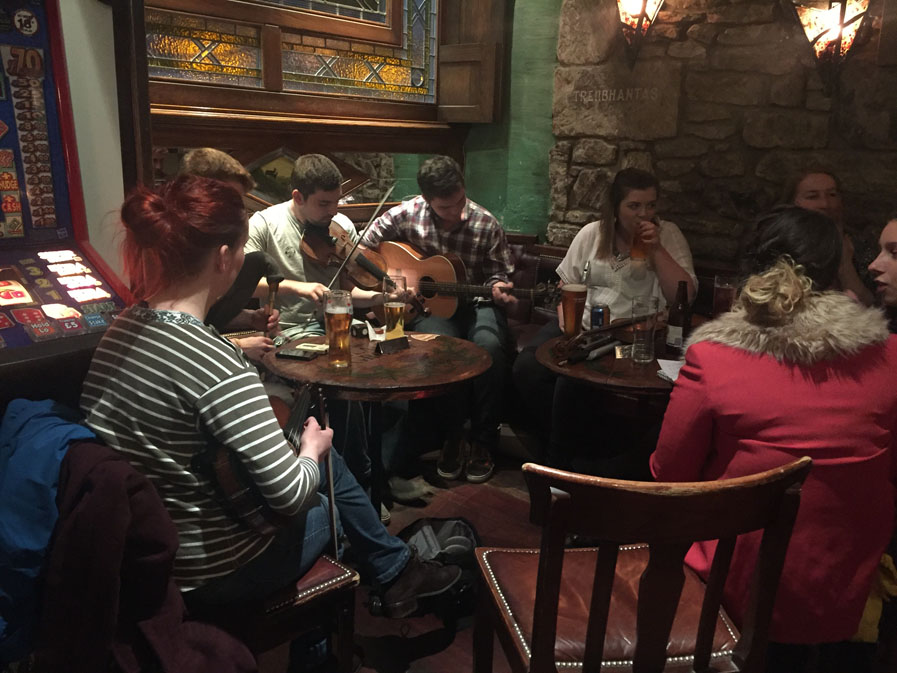
First off was the Gaelic music session at the Lios Mòr (Lismore) pub in Partick on the first Wednesday of the month. I went along and for the first hour enjoyed the music but didn't really know anybody. However, Calum (of Beag Air Bheag fame) introduced himself to me and we had a good chat for half an hour in Gaelic, then I met a really nice guy MB who was also a more advanced learner, and we chatted for the rest of the night. It was a brilliant evening. I guess, though, like any pub night, you will have some nights that are quiet and others that are terrific.


Two nights later on the Friday night I was in the basement of the Argyll Hotel on Sauchiehall Street at Àdamh O' Broin's event, the An Gealbhan social. The night I went was a quiet night and my Gaelic wasn't quite up to the fluency of the others there, but it was a fun and interesting evening.


Next day, by pure luck, the Irish/Scottish group Gaels Le Cheile put on a day of language classes, aimed mainly at those looking to learn Irish Gaelic but also with sessions for those of us looking to improve our Scottish Gaelic. As such, I spent a fantastic day with the brilliant Joy Dunlop, going through a ton of pronounciation exercises and other really useful stuff. The event was, sadly, under-subscribed but I wonder if that's because there wasn't a huge amount of advance notice given. I would seriously take a day off work and make the trek from Dover to Glasgow for another session like that.

Finally, the following Wednesday, I made the journey back to Partick for the lunchtime session at the Gaelic Bookshop (An Lèanag) with Inbhich gu Fileanteas, a structured two hour weekly session for those looking to improve their Gaelic fluency. It was a super crowd and I was made to feel warmly welcome. The two hour session is led by two separate fluent Gaelic speakers and it was a really worthwhile experience; so much so that I shall be heading back hopefully once every month or two just to catch up with them all as work and finances allow.


Let's not forget that there are plenty of other opportunities in Glasgow to put your Gaelic skills to test, whether it is craic at the Park Bar or one of the many other formal learning events that take place through the university or through An Lòchran.


Sadly, the combination of migraine attacks and needing to go to work at weekends curtailed my activities and I didn't get to as many events as I had originally planned. But I have to say, if you're looking for somewhere to go and practice your Gaelic and you are prepared to 'put yourself out there', Glasgow is definitely the place. 


Thursday, 16 July 2015

Coffee and Craic - what next?


It was with great sadness that I read on Facebook that Coffee and Craic, the Gaelic Cafe in Glasgow, has closed:

https://www.facebook.com/CoffeeAndCraic

A short while ago I blogged about the place, saying how valuable and welcome it was to me as a Gaelic learner, and no doubt countless others too.

However, as we all know, love and support does not a business grow. Footfall and money is what is needed. It appears that the location of the cafe did not encourage enough footfall to make it commerically viable. Also, let's be honest, the Gaelic speaking and learning community isn't huge. It is also spread out across the world. It was a great place for this guy in Kent to meet his Gaelic-learning buddies from the USA, but that's not enough to keep a business running, sadly.

With no money to keep a team of staff on, poor Sarah ended up having to reduce the opening hours, and if a family crisis cropped up then the cafe had to close. Thus the ever-decreasing circle took effect until such a time that, for the moment at least, Coffee and Craic remains closed. I'm so sad about it.

However...

I'm not privvy to Inside Information, but I would hope that lessons have been learned. According to the notice on Facebook, new City Centre premises are being sought to help increase the footfall, and therefore the sustainability, of Coffee and Craic. Its former location was handy for the Gaelic school, but it seemed that many folks, myself included, travelled there specially from outwith Glasgow, and the trek from the city centre to the West End was a bit of a drag.

My thoughts now turn to the new, city centre Coffee and Craic. I was prepared to travel from Kent on the train for a couple of days hanging out with the likes of 'Gàidhlig gun Bheurla' with Àdhamh, especially if I could catch a 'Togaibh Fonn' session as well. However, we all know that travel and accommodation are only really affordable if you pay in advance and book the non-refundable option. You're looking at at least £100 for a trip to Glasgow for many people, even if you book anti-social trains and stay at the Ibis Budget. However, that's more than worth it for sessions with the likes of Àdhamh. Glasgow is a LOT easier to reach than Sabhal Mòr Ostaig for the great majority of people. However, I didn't book these trips as it couldn't be guaranteed that the cafe would be open.

Coffee and Craic, for some of us, was not just a cafe. It was a destination in itself, the very reason I'd figure Glasgow into my trips to Scotland. For this reason alone, the new incarnation has simply got to be reliable and be open when advertised without short-notice closure. This is way too much to ask of one woman, and I hope the management have realised this.

In my ideal world, Coffee and Craic would also have rooms upstairs for out-of-town guests to sleep over, to save having to stay in a hotel. There is no facility (to my knowledge) for us learners to stay in a Gaelic environment other than a short course at Sabhal Mòr Ostaig or the occasional summer week on Uist. If the new Coffee and Craic is a reliable centre that hosts affordable weekends/midweek breaks where the likes of us learners can chill and socialise in a Gaelic-speaking environment, then I'd definitely help CrowdFund that!

Whatever happens, I wish the team well and offer my full support. I just don't want to lose this wonderful resource.


Monday, 23 February 2015

Pop Idol


image credit: twitter.com


I've never been one for idolising people. After all, we're ALL only human whether you are David Beckham or Stephen Hawking. I guess the reason that I've never really idolised or admired anyone is because I've never REALLY strived to do anything much in the past, other than be a good person and be good at what I do. An over-privileged spotty yoof on TV who thinks that an average singing voice is the passport to an easy future does little to inspire and earn the respect of this cynical individual.


Thanks to Gaelic, I now have an idol. In fact, I have many idols. For a start, I look up in awe to absolutely anybody that is fluent in Gaelic.

However, top of the tree in my eyes are those who have reached fluency as adult learners. Topping even these awe-inspiring people are the non-Scottish folks who have managed it.

The man I most idolise, and whose shoes I am not fit to polish, is the BBC reporter Andreas Wolff. This German National learned Gaelic to such fluency that he is now a presenter for BBC Alba, the BBC's Gaelic language channel.

Just think about that for a minute. Imagine how amazingly good you have to be and how incredibly hard you have to work in order to acheive such an incredible feat. The man is, in my eyes, a God. Those who have had the pleasure of meeting him also inform me that despite his amazing skill and intellect, he's also a thoroughly decent and charming bloke. This man, Andreas Wolff, is my all-time idol. The Gaelic community is a small one and I am sure that our paths will cross in the future. I have no doubt that this man's presence will reduce me to a gibbering wreck.

Not far behind him is a fellow Englishman, Charles (Teàrleach) Quinell, another non-Scot who has also acheived fluency to the point of being able to present on BBC Alba.

Joy Dunlop and Àdamh O Broin are another two learners who have carved careers in Gaelic despite learning as adults (so I understand), and in their company I also feel completely unworthy. I've been privileged enough to meet both of them, and you'd be hard pushed to meet two more lovely, enthusiastic, charismatic, gifted, and charming people.

I am sure that there will be more people that I learn about along the way who have managed to lick this language to the point of being able to work with it and earn the respect of native Gaelic speakers. I'm not quite sure where my own Gaelic journey is going, but people like Andreas, Teàrleach, Joy, and Àdhamh provide the kind of inspiring role models that vacuuous mainstream media can only dream about.  It's yet another reason why I love Gaelic so.